
What connections are there between different thinking skills?
This network graph represents the conceptual relations between the components of four thinking skills.
Each of the four skills is divided into 14 components. The pop-ups define each component, but note that such definitions vary between authors and literatures. Individual thinking skills can be included or excluded using the legend.
Where components are similar or identical, they are connected. For example, see the components related to problem-solving, iteration and ambiguity. These play a central role in more than one thinking skill, even though they are often described as distinctive characteristics of each skill.
The components and relationships presented here are derived from those explored in Section 7 of a conceptual analysis, detailed on the About page. The components are an aggregation of multiple published descriptions of each concept, as illustrated in Appendix C.
Although there are clear overlaps between the components used to define each skill, the relevant literatures are quite separate from each other:
(1) critical thinking (2) design thinking (3) systems thinking (4) creative thinking (5) computational thinking (6) entrepreneurial thinking
This network map represents relations between reference lists of articles discussing six thinking skills.
The map represents data from research articles published in 2025, which, in their title, refer to: (1) critical thinking; (2) design thinking; (3) systems thinking; (4) creative thinking; (5) computational thinking; (6) entrepreneurial thinking. For each skill, 250 articles were collected from the Dimensions database, and their bibliographic coupling was determined.* Articles that have many common documents in their reference lists are closely associated with each other, compared to those that share only a few. From the set of 1500 articles, 848 exhibited such links in their reference lists, and all those articles are included here.
The map has controls and displays (surrounding the map). The view panel (right) permits zooming in and out of the network. Details about each node and edge can be inspected (bottom). The control panel (left) permits the data variables that determine the scaling and colouring to be selected, and the display variables to be adjusted. Visualisations can be saved and shared in various ways (top).
The recency of the articles means their citation count is not informative. This frees up that bibliographic variable to be used for storing the skill numbers referred to in each article’s title, as indicated above (1 = critical thinking; 2 = design thinking, etc.). This numbering determines the colouring in the default view, with the sizing determined by link strength. When inspecting the information panel, the details of each article can be reviewed (Authors, Title, etc.), with the skill number indicated next to the label for Citations. Full bibliographic details, including true citation counts, can be accessed by selecting the URL in the information panel.
From this map, we can observe that articles referring to each skill are clustered together and largely disconnected from the other skills. However, some isolated articles appear in other clusters. That is, they share more of their reference lists with articles referring to other skills than they do with articles referring to the same skill. Critical thinking and creative thinking are quite closely associated, but entrepreneurial thinking and computational thinking are more separate.
* For entrepreneurial thinking, sufficient publications were only reached when including publications from 2025 and 2024, which referred to entrepreneurial thinking, entrepreneurial attitude or entrepreneurial mindset. For further details about terminological diffusion for this concept, refer to the conceptual analysis outlined on the About page.
The map above represents the connections between the reference lists of articles focused on different thinking skills, but are the separations this shows reflective of the underlying concepts being explored?
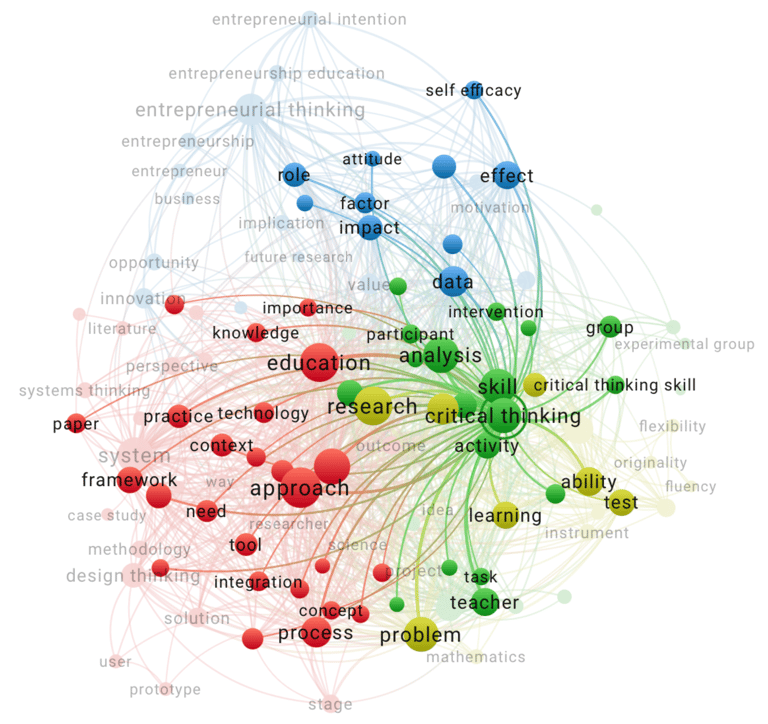
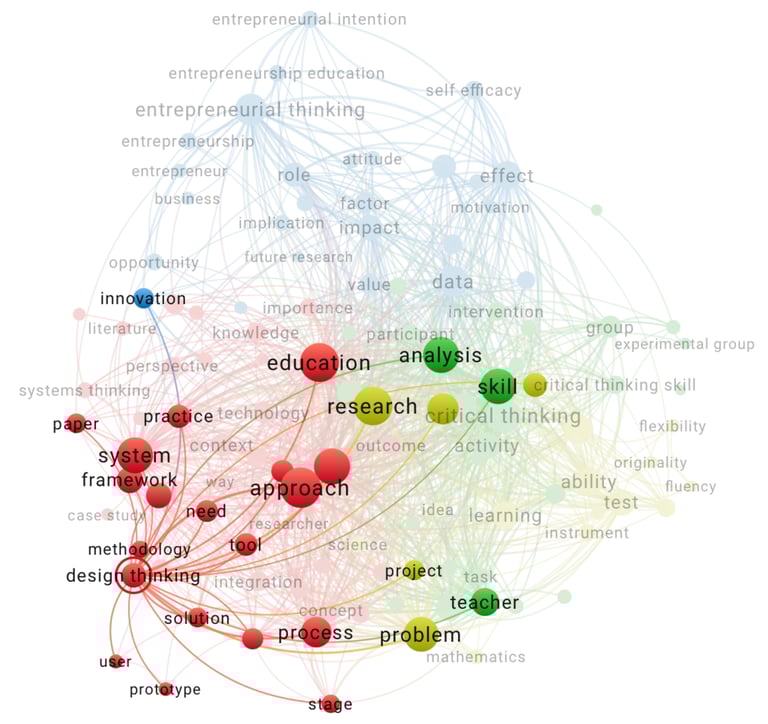
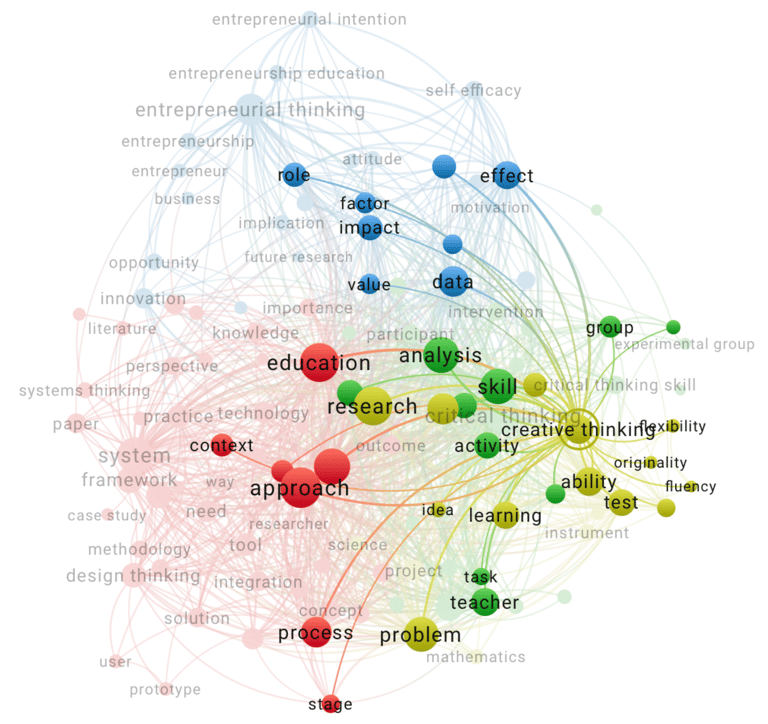
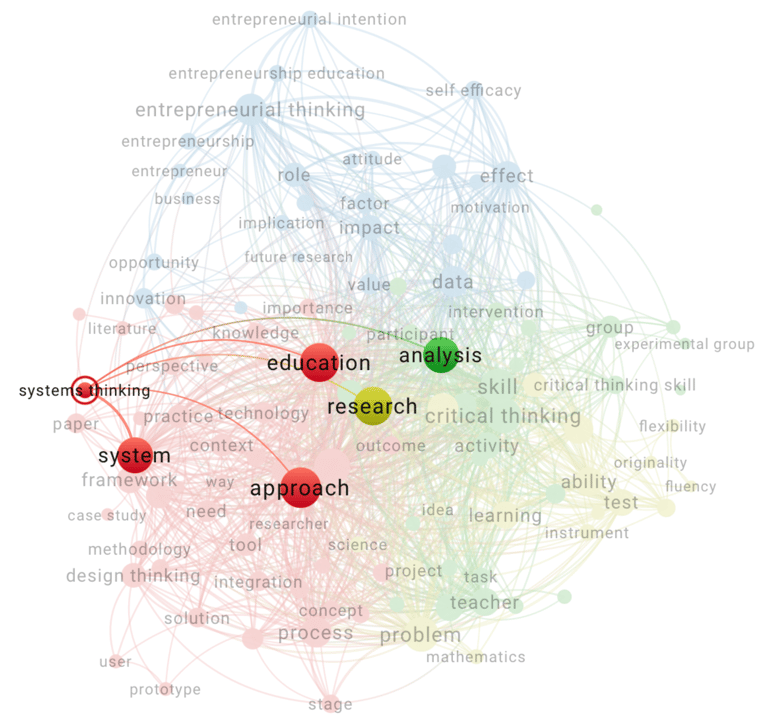
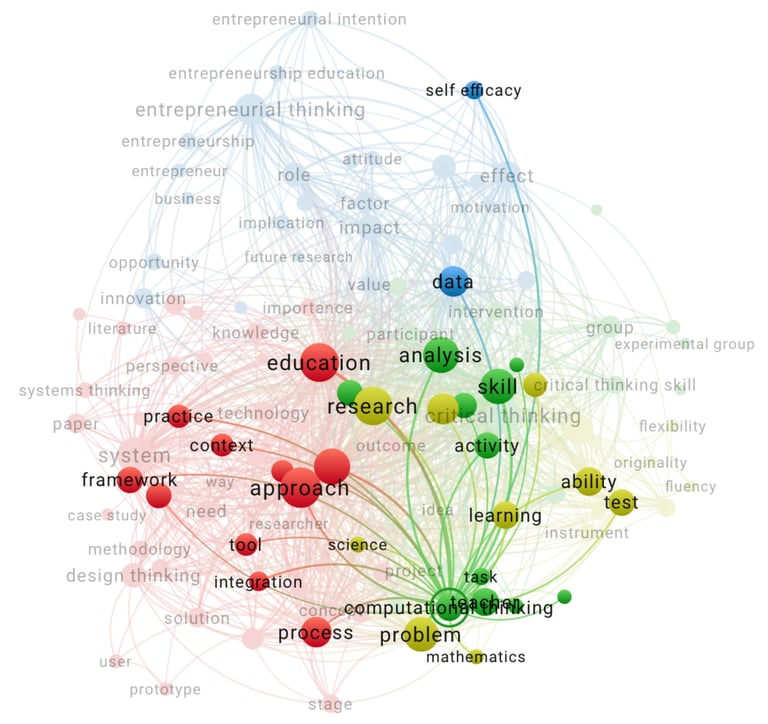
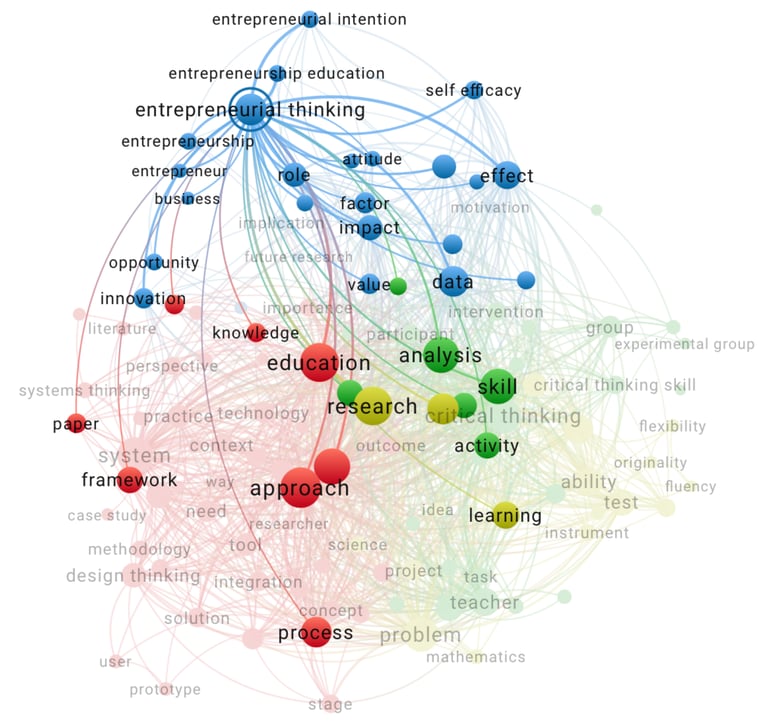
This network map represents relations between the terms used in articles discussing six thinking skills.
Using the dataset described above, the data were prepared for further analysis by removing any articles that did not have full abstracts written in English. Retaining equal numbers of articles for each skill reduced the set to 160 articles per skill (960 articles in total). The map of term co-occurrences was built from the title and abstract fields, ignoring structured abstract labels, and using full counting (instead of binary counting). This resulted in 21,700 terms being extracted from the corpus, which was reduced to 122 by eliminating any terms with fewer than 50 occurrences. No relevance filter was applied, but for clarity, the two most common terms were removed: “student” and “study.” To aid comparison across skills, the terms “entrepreneurial mindset” and "entrepreneurial attitude” were combined with "entrepreneurial thinking,” and “system thinking” was combined with “systems thinking.” The colours are determined by clustering, not by the terms in the titles.
Selecting each of the six thinking skills highlights the terms they most often appear with. This is illustrated in the six map views below. Note that certain terms are commonly associated with each of the six skills, including “education.” However, the previous separations are again found here: computational thinking separated from entrepreneurial thinking; systems thinking separated from creative thinking.
Questions? Ideas? Get in touch.
© Nathan Crilly 2026